
4
You are sitting in the dealership waiting area for a routine oil change when the service advisor approaches with a clipboard and a concerned expression. Before you know it, a standard fifty-dollar visit has ballooned into a proposed three-hundred-dollar invoice, largely due to a highly recommended fuel injector cleaning service. The advisor might mention carbon buildup, lost performance, or sluggish fuel economy. For the average driver, this pitch sounds intimidating and perfectly logical. After all, nobody wants a failing engine.
But this scenario leaves millions of car owners asking the same question every year: is a professional fuel injector cleaning a vital piece of vehicle maintenance, or is it just a high-margin profit center designed to pad the dealership’s bottom line?
The truth lies somewhere in the middle. While fuel injectors certainly do get dirty and can severely impact engine performance, the frequency and method of cleaning recommended by many service centers often border on predatory. Understanding the mechanics of your engine, the chemistry of modern gasoline, and the actual symptoms of a clogged injector is the only way to protect both your vehicle and your wallet.
The Mechanics of Fuel Injection
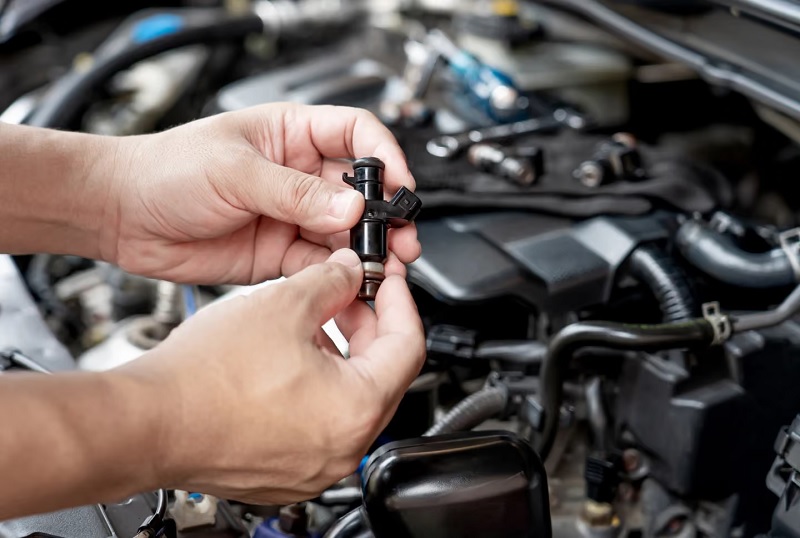
To understand why a fuel injector might need cleaning, you have to understand the incredibly precise job it performs. A fuel injector is essentially an electronic valve that receives pressurized fuel from the fuel pump. When the engine’s computer sends an electrical signal, the injector opens for a fraction of a millisecond, spraying a highly atomized mist of gasoline directly into the intake manifold or the combustion chamber.
For an engine to run efficiently, this spray pattern must be a perfect, uniform cone. The microscopic holes at the tip of the injector are often thinner than a human hair. Because they operate in an environment of extreme heat and pressure, they are highly susceptible to contamination. When you turn off your engine, a phenomenon known as heat soak occurs. The remaining fuel sitting on the tip of the hot injector bakes, leaving behind a microscopic layer of carbon and varnish. Over tens of thousands of miles, these deposits accumulate, slowly distorting the spray pattern from a fine mist into a sloppy, uneven stream.
When fuel is not properly atomized, it does not burn efficiently. This unburned fuel is pushed out through the exhaust, forcing the engine to work harder and consume more gasoline to generate the same amount of power.
The Dealership Upsell: Why It Gets Pushed So Hard
If fuel injectors naturally accumulate carbon, why do automotive experts often advise skepticism when a dealership recommends a cleaning? The answer lies in the business model of automotive service departments.
Dealership service bays operate on flat-rate billing, and service advisors frequently work on commission. A chemical fuel injector flush is known in the industry as a high-margin service. It requires very little physical labor, taking a technician perhaps fifteen to twenty minutes to hook up a pressurized canister to the fuel rail and let the engine run until the cleaning solvent is exhausted. Despite the low labor requirement, dealerships routinely charge anywhere from one hundred and fifty to nearly three hundred dollars for this procedure.
Because of this lucrative profit margin, many dealerships bundle fuel system cleanings into their in-house “recommended maintenance” menus at arbitrary intervals, such as every thirty thousand miles. However, if you open the actual owner’s manual provided by the vehicle manufacturer, you will rarely find a fuel system flush listed as a scheduled requirement. Automakers engineer their vehicles to run on commercially available gasoline without the need for constant chemical interventions. When a service is aggressively pushed based on mileage rather than actual mechanical symptoms, it is almost certainly a wallet flush rather than a necessary procedure.
When Fuel Injector Cleaning Is Actually Necessary
Despite the frequent upselling, dirty fuel injectors are a real mechanical issue. Dismissing the service entirely can lead to severe drivability problems. The key is learning to recognize the tangible signs that your engine is actually starving for a clean fuel spray.
Direct Injection Engines Face Higher Risks
The type of engine under your hood plays a massive role in how quickly your injectors will foul. Older vehicles, and some modern ones, use Port Fuel Injection (PFI). In a PFI system, the injector sprays fuel into the intake manifold, just behind the intake valve. Because gasoline acts as a natural solvent, this constant spray continually washes the intake valves and the injector tips, keeping them relatively clean.
However, most modern vehicles rely on Gasoline Direct Injection (GDI) to meet strict fuel economy and emissions standards. In a GDI engine, the injector is placed directly inside the combustion chamber. It is exposed to the violent, explosive heat of combustion every single second the engine is running. Furthermore, because the fuel is injected directly into the cylinder, it never washes over the intake valves. GDI injectors are far more prone to rapid carbon buildup and baking. If you drive a vehicle with a GDI engine, professional fuel system cleanings are legitimately necessary, though usually not until the vehicle has surpassed sixty to eighty thousand miles.
Noticeable Performance Symptoms
You should rarely agree to a fuel injector cleaning as preventative maintenance unless you are experiencing specific drivability issues. The most common symptom of a clogged injector is a rough idle. If you are sitting at a red light and the steering wheel or dashboard feels like it is vibrating irregularly, your engine is likely experiencing a lean misfire due to restricted fuel flow.
Other symptoms include engine hesitation or stumbling when you press the accelerator, a sudden and unexplained drop in your miles per gallon, or a distinct smell of raw, unburned gasoline from the exhaust. If the clog becomes severe enough, the vehicle’s computer will trigger a Check Engine Light, usually throwing a diagnostic trouble code for a cylinder misfire or a lean running condition.
The Ultimate Proof: Fuel Trims
If you want to completely disarm an aggressive service advisor, ask them to show you the vehicle’s fuel trim data. The engine control unit constantly monitors the oxygen sensors in the exhaust. If an injector is clogged and spraying less fuel, the oxygen sensor detects too much air in the exhaust. The computer compensates by increasing the Long Term Fuel Trim (LTFT), demanding that the injectors stay open longer. If your service advisor claims you need a cleaning, but your fuel trims are reading perfectly close to zero, they are selling you a phantom repair. If the fuel trims are elevated beyond five to ten percent, the cleaning is genuinely warranted.
The Difference Between a Bottle and a Professional Flush
If you determine that your fuel injectors actually need attention, you have to decide between a cheap bottle of fluid from the auto parts store and the expensive dealership service.
Over-the-Counter Fuel Additives
The shelves of any auto parts store are lined with brightly colored bottles promising to restore your engine to factory performance for under twenty dollars. These pour-in tank additives are generally weak, heavily diluted solvents. However, those that contain a high concentration of Polyether Amine (PEA) are actually scientifically proven to break down carbon deposits over time.
Pour-in additives are strictly preventative. If you pour a bottle of a PEA-based cleaner into your gas tank right before a long highway road trip every ten thousand miles, it will do an excellent job of preventing heavy carbon buildup from forming in the first place. What these bottles cannot do is fix an injector that is already severely clogged. The solvent is too diluted by the gallons of gasoline in your tank to punch through baked-on, hardened carbon.
Professional Pressurized Cleaning
When a dealership or independent mechanic performs a proper fuel injector cleaning, they do not just pour a bottle into your gas tank. They disable the vehicle’s fuel pump and connect a pressurized canister of concentrated, industrial-grade cleaning solvent directly to the engine’s fuel rail. The engine is then started and forced to run entirely on this potent cleaning chemical until the canister is empty.
Because this solvent is undiluted and highly pressurized, it is aggressive enough to dissolve hardened varnish, blast away carbon deposits from the injector pintles, and restore the factory spray pattern. If you are experiencing genuine performance issues related to fuel starvation, this professional service is absolutely worth the money.
Protecting Your Engine and Your Wallet
The best way to avoid the fuel injector cleaning debate altogether is to feed your engine properly. The Environmental Protection Agency requires all gasoline sold in the United States to contain a minimum level of engine-cleaning detergents. However, decades ago, major automakers realized this minimum standard was simply not enough to keep modern, high-compression engines clean.
In response, they created the Top Tier Detergent Gasoline standard. Gas stations that display the Top Tier logo voluntarily add significantly higher concentrations of proprietary detergents to their fuel. Consistently filling up your vehicle at Top Tier stations is the single most effective way to keep your fuel injectors clean naturally. The detergents work continuously, dissolving nascent carbon deposits every time you drive.
Ultimately, fuel injector cleaning is not a scam, but it is heavily exploited. It is a legitimate, highly effective mechanical procedure that has been hijacked by the automotive service industry as a quick way to boost revenue. By understanding how your engine works, relying on Top Tier fuels, and waiting for actual symptoms rather than arbitrary mileage intervals, you can confidently turn down the service advisor’s upsell while ensuring your vehicle runs flawlessly for years to come.
