
3
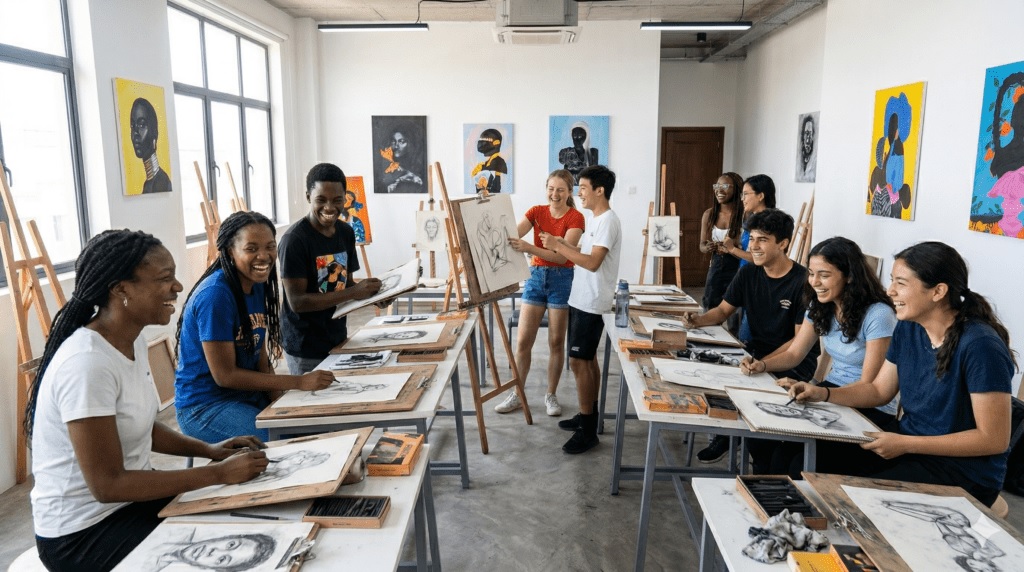
Every year, school districts across the country face the dreaded budget review, and almost universally, the arts are the first programs placed on the chopping block. Painting, theater, and music are frequently categorized as luxury electives—pleasant diversions that must gracefully step aside for the serious business of mathematics, science, and standardized testing. But this binary approach to education represents a fundamental misunderstanding of how the human brain actually develops. Arts education is not a decorative trim on the house of learning; it is the load-bearing foundation. By systematically sidelining the creative disciplines, we are depriving students of the exact tools they need to develop genuine self-assurance, emotional maturity, and adaptable, innovative thinking.
The Cognitive Mechanics of the Creative Process
To understand the true value of the arts, we have to look past the final product. The true educational value does not lie in the finished ceramic bowl or the final curtain call; it lies in the intense cognitive load and internal processing that happens during creation. Standard academic structures heavily prioritize algorithmic thinking, where a student memorizes a formula, applies it to a specific problem, and arrives at the single correct answer.
Art operates in an entirely different neurological landscape. It demands divergent thinking. When a student is handed a lump of clay, a blank canvas, or an unlearned piece of sheet music, there is no hidden answer key at the back of the textbook. They must make a series of independent, highly subjective decisions. They have to conceptualize an outcome that does not yet exist and then reverse-engineer the physical steps required to bring that concept into reality. This forces the brain to build entirely new neural pathways, bridging the gap between abstract imagination and concrete execution.
Forging Resilience Through Iteration
In traditional classrooms, a failing grade often feels like a permanent dead end. In an art studio, failure is the active ingredient of progress. A creative endeavor is rarely executed flawlessly on the first attempt. When a brushstroke goes awry, when a photographic exposure is ruined, or when a theatrical cue is entirely missed, the student is forced to pivot in real-time.
They must step back, assess the damage objectively without completely abandoning the project, and devise a new strategy to move forward. This iterative process of making mistakes and correcting the course builds a profound cognitive resilience. Students learn that a misstep is not an indictment of their intelligence, but simply data that informs their next attempt. This ability to absorb a setback, adapt, and push forward translates directly into every other facet of their academic and personal lives.
Cultivating Authentic Self-Confidence
Confidence is frequently misunderstood as a natural, inherent personality trait. In reality, it is a learned behavior. It is built through the repeated experience of tackling something difficult, surviving the intense vulnerability of the process, and emerging successfully on the other side.
For many adolescents, speaking in public or expressing a personal viewpoint is a terrifying prospect. The arts force students directly into this arena of vulnerability, but within a highly structured, supportive environment. When a middle school student stands on a stage to deliver a monologue, their voice might shake and their hands might tremble. But the physical act of pushing through that visceral fear teaches them something indelible about their own capabilities. They learn that their voice carries weight, their unique ideas have merit, and their physical presence commands space.
The Eradication of “Right Answer” Anxiety
A significant portion of modern students suffer from crippling perfectionism because they are terrified of getting the wrong answer. The high-stakes testing environment breeds an anxiety that paralyzes their willingness to participate or guess. Arts education provides a critical sanctuary from this specific brand of anxiety.
In a jazz ensemble, an improvised solo is not objectively right or wrong; it is an exploration of sound and rhythm. In a creative writing workshop, a poem is evaluated on its emotional resonance rather than its adherence to a rigid metric. This freedom from absolute, punitive grading allows anxious learners to take intellectual risks. They begin to trust their own instincts and intuition, which is a vital component of deep-seated self-assurance. Once a student learns to trust their own voice in the art room, they are far more likely to raise their hand in a high-stakes chemistry or history class.
The Intersection of Art and Emotional Intelligence
The arts are fundamentally the study of the human condition. A student cannot authentically perform a role in a play without first dissecting the underlying motivations, fears, and history of the character they are portraying. They cannot thoughtfully critique a piece of historical artwork without considering the societal pressures and cultural environment the artist was navigating.
Through these disciplines, students practice active empathy. They are forced to routinely step outside their own lived experiences and inhabit the perspectives of others. In a fragmented and increasingly digital world, this ability to deeply understand and connect with varying viewpoints is becoming a remarkably rare commodity.
Furthermore, students who participate in collaborative arts—such as a marching band, a choir, or a large-scale theater production—learn the intricate mechanics of complex teamwork. They realize quickly that their individual contribution is vital, but that true success requires harmonizing with the people around them. They learn to take direction, offer constructive criticism without cruelty, and support their peers when they stumble. These are the foundational pillars of high emotional intelligence.
Accelerating Traditional Academic Achievement
There is a persistent, damaging myth that the arts and STEM (Science, Technology, Engineering, and Mathematics) are warring factions competing for limited educational resources. In reality, they are highly synergistic. The skills developed in the art room act as powerful catalysts for traditional academic achievement.
Consider the profound mathematics underlying a musical composition. When a child learns to read sheet music, they are actively decoding fractions, ratios, and temporal sequencing in real-time. When a student builds a large-scale ceramic sculpture or designs a theatrical set, they are intuitively grappling with physics, weight distribution, structural engineering, and spatial reasoning. The spatial-temporal reasoning developed through learning to play an instrument has been repeatedly shown to enhance a student’s ability to grasp complex mathematical equations. By weaving the arts deeply back into the core curriculum, we are not distracting from STEM; we are providing a practical, tactile laboratory for it.
Preparing for an Unpredictable Economic Future
Looking toward the trajectory of the modern workforce, the demand for algorithmic, repetitive labor is plummeting. Artificial intelligence, machine learning, and advanced automation are rapidly absorbing the tasks that rely on rote memorization and basic computation. The high-paying, secure jobs of the future will belong exclusively to the synthesizers—the individuals who can look at disparate pieces of information, find the hidden connections, and generate entirely new solutions.
The corporate world routinely lists adaptability, creative problem-solving, and emotional intelligence as the absolute most sought-after traits in new hires. These are not skills that can be effectively taught through multiple-choice testing or standard lectures. They are cultivated entirely in the art studio, the rehearsal hall, and the design lab. An arts education teaches students how to tolerate ambiguity, how to communicate complex ideas visually and emotionally, and how to innovate when the traditional, established methods fail.
We must stop demanding that our schools operate like industrial factories, churning out uniform products optimized only for standardized testing. The human mind is not a hard drive designed merely to store and retrieve data; it is a profound engine of creation. When we place a paintbrush in a child’s hand, hand them a script, or teach them to read a musical staff, we are giving them the specific tools to construct their own identity. We are teaching them to look at a blank space and realize that they possess the innate power to fill it with something meaningful. Ensuring that every single student has robust access to the arts is not a matter of educational luxury. It is a fundamental requirement for raising a generation capable of facing the complexities of the future with unshakeable confidence and boundless imagination.
