
4
Walking into an appliance showroom can easily overwhelm even the most disciplined shopper. Aesthetically pleasing stainless steel finishes, smart touchscreens, and aggressive holiday sale banners dominate the floor. In this environment, it is incredibly easy to base a purchasing decision entirely on the upfront retail price. However, treating a major appliance purchase like a standard retail transaction ignores a fundamental financial reality. When you buy a refrigerator, a washer, or an air conditioning unit, you are not just making a one-time purchase. You are essentially signing a binding, decade-long subscription contract with your local utility company.
The true financial impact of an appliance is divided into two distinct categories: the capital cost required to bring the unit home, and the operational cost required to keep it running day after day. A washing machine that is two hundred dollars cheaper at the register can easily consume five hundred dollars more in electricity and water over its lifespan. Understanding how to interpret efficiency ratings and project long-term utility costs is the only way to calculate the true price of an appliance and protect your household budget from invisible, creeping expenses.
The Anatomy of the EnergyGuide Label
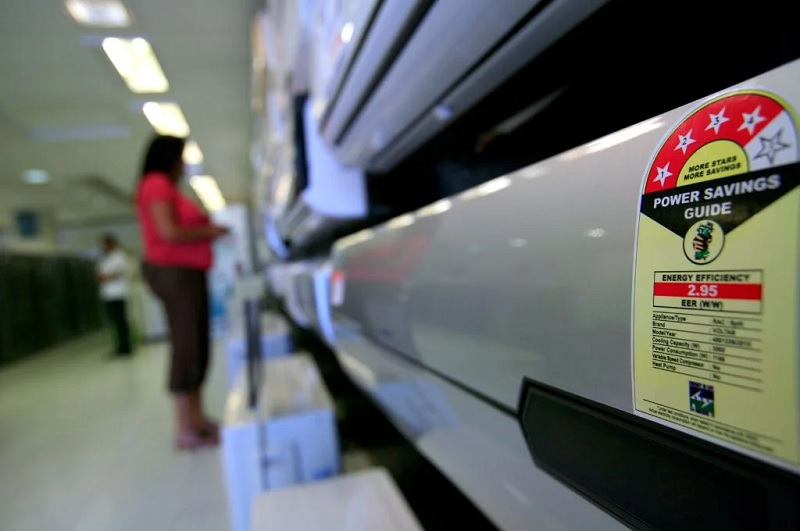
Before you can calculate long-term costs, you must understand the data presented to you on the showroom floor. Federal law mandates that most major appliances display a bright yellow EnergyGuide label. This label is not merely a piece of marketing collateral; it is a standardized financial forecasting tool designed to strip away manufacturer spin and provide raw operational data.
Interpreting the Critical Metrics
The most prominent number on the yellow tag is the estimated yearly operating cost, printed squarely in the center. While this number provides a helpful quick-glance baseline, it is inherently flawed because it relies on a national average for electricity rates. If you live in a region with exceptionally high utility costs, such as the Northeast or the West Coast, this centered dollar amount will significantly underestimate your actual expenses.
To perform a highly accurate evaluation, you must look below the estimated cost to find the estimated yearly electricity use, measured in kilowatt-hours (kWh). This is the most crucial metric on the entire label. It represents the raw, unmanipulated amount of electrical fuel the machine requires to operate for twelve months under standard testing conditions. By isolating the kWh consumption, you remove the variable of fluctuating national average prices and gain the exact data point needed to calculate your hyper-local costs.
Decoding the Energy Star Certification
While the yellow EnergyGuide label provides raw data for all tested appliances, the blue Energy Star logo functions as a highly exclusive certification. Administered jointly by the Environmental Protection Agency and the Department of Energy, this badge is awarded only to models that meet strict efficiency criteria, generally performing in the top twenty to thirty percent of their respective categories.
An Energy Star certified appliance does not just consume less electricity; it often utilizes entirely different, advanced engineering architectures to achieve that efficiency. For example, a certified refrigerator typically features vastly superior cabinet insulation, high-efficiency compressors that adjust their speed rather than simply clicking on and off, and advanced defrost mechanisms. Therefore, the logo serves as a reliable shorthand for superior build quality and advanced thermodynamic engineering. However, simply buying an appliance with a blue sticker is not enough; you must still calculate the financial math to ensure the premium price of that advanced engineering will actually pay for itself.
Calculating Your True Total Cost of Ownership
To bridge the gap between the showroom price and your future utility bills, you must calculate the Total Cost of Ownership (TCO). This formula reveals the actual financial weight of the appliance over its expected lifespan, allowing you to compare a cheap, inefficient model directly against an expensive, highly efficient model on a level playing field.
The Mathematics of Projected Expenses
To execute this calculation, you first need to find your exact residential electricity rate. Pull your most recent electric bill and divide your total balance by the total number of kilowatt-hours used. This will give you your true cost per kWh, inclusive of delivery charges and taxes.
Next, take the estimated yearly kWh usage from the appliance’s EnergyGuide label and multiply it by your local rate. This provides your exact annual operating cost. Finally, multiply that annual cost by the expected lifespan of the appliance—which is generally ten to twelve years for modern washing machines and dishwashers, and twelve to fifteen years for refrigerators.
When you add this lifetime operating cost to the initial retail price tag, the financial picture often flips entirely. The premium Energy Star model, which felt prohibitively expensive at the register, frequently emerges as the cheapest option when evaluated across a ten-year horizon.
Weighing the Payback Period
When analyzing the Total Cost of Ownership, the most practical metric for decision-making is the payback period. This is the exact amount of time it takes for the monthly utility savings to completely offset the higher initial purchase price of an efficient model.
If a highly efficient heat pump clothes dryer costs three hundred dollars more upfront than a traditional electric resistance dryer, but saves you sixty dollars a year in electricity, your payback period is exactly five years. Once you cross that five-year threshold, the appliance begins generating a pure financial return on your investment. If you plan to live in your current home for the next decade, absorbing a longer payback period makes perfect financial sense. However, if you are outfitting a property you intend to sell in two years, paying a massive premium for efficiency will not yield a return before you hand over the keys.
High-Impact Appliances: Where Efficiency Matters Most
Not all appliances drain your wallet equally. If you are operating on a tight renovation budget and must choose where to allocate your funds, prioritizing efficiency in certain high-impact categories will yield a drastically higher return on investment.
The Relentless Draw of Refrigeration
Refrigerators are entirely unique in the world of home appliances because they are the only major units that never power down. They draw a constant, twenty-four-hour load to fight against the ambient heat of your kitchen. Upgrading a refrigerator that is more than a decade old to a modern Energy Star model is often one of the fastest ways to reduce a baseline residential power bill. Furthermore, configuration matters immensely. Standard top-freezer models are inherently more efficient than complex side-by-side units, and heavily insulated doors without external ice and water dispensers will always retain cold air more effectively.
The Evolution of Laundry Technology
Washing machines and dryers are massive consumers of both electricity and water. In the washing machine category, the shift from traditional agitator top-loaders to high-efficiency front-loaders has revolutionized utility consumption. Front-loaders tumble clothes through a small pool of water rather than filling a massive drum, saving thousands of gallons of water per year and drastically reducing the electricity required by the home’s water heater.
In the drying category, standard vented dryers are essentially giant heat lamps that forcefully exhaust the conditioned air from your home to the outdoors. The introduction of ventless heat pump dryers represents a massive leap forward. Instead of generating raw heat through electrical resistance, these units extract ambient heat from the room, compress it, and recycle it through the drum. While they carry a significant upfront premium, they operate on a fraction of the electricity required by traditional models and represent a massive long-term financial victory for households that do heavy laundry volumes.
Avoiding the Oversizing Trap
Even the highest Energy Star rating cannot protect you from the financial penalty of oversizing. Many consumers fall into the trap of purchasing massive, commercial-grade appliances under the assumption that bigger is inherently better.
An oversized air conditioning unit will short-cycle, constantly turning on and off before it can properly dehumidify a space, causing unnecessary wear and massive energy spikes. An oversized, eighty-gallon water heater in a two-person household will burn fuel around the clock to keep a massive reserve of water hot that will never actually be utilized. When you buy a larger appliance than your household actually requires, you pay a premium at the register and then pay an ongoing penalty on every subsequent utility bill. Accurately matching the capacity of the appliance to your actual daily usage habits is just as critical as checking the efficiency rating.
Ultimately, stepping onto a showroom floor equipped with the knowledge to decode utility consumption transforms you from a passive consumer into a strategic financial manager. By looking past the polished chrome and aggressive sales tags, and rigorously calculating the Total Cost of Ownership and the corresponding payback period, you secure more than just a new piece of machinery. You effectively protect your future monthly cash flow, ensuring that the convenience of a modern home does not quietly erode your long-term financial health.
